
Quick answer: Home care is often the right choice in the early stages of dementia, when safety risks are low and a loved one can stay comfortably at home with some help. Memory care—a secured residential community with staff trained in dementia and available around the clock—often becomes the better choice as the disease progresses and needs include consistent supervision and specialized behavioral support.
Memory Care vs. Home Care: Which Is Right for a Loved One with Dementia?

When a parent or spouse is diagnosed with Alzheimer’s or another form of dementia, one of the first big questions families face is where care should happen. Should your loved one stay home with help coming to them, or would they be safer and better supported in a dedicated memory care community?
The answer depends on the stage of the disease, your family’s resources, and what your loved one needs to stay safe and engaged.
This guide breaks down the real differences between memory care vs. home care so you can make an informed decision. To provide the best answers, we turned to the team who provides this care every day in the Serenata Memory Care neighborhoods at Living Branches.
What Is Home Care for Dementia?
“Home care means your loved one stays in their home while support comes to them,” explains Melissa Galvan, care coordinator for Personal Care at Souderton Mennonite Homes. “This can mean family members, hired in-home aides, or both. In the earliest stages of dementia, home care preserves familiar surroundings and routines.”
Home care is generally a good fit when:
- Memory loss is mild
- Safety risks are low
- There is strong, reliable family support nearby
- Your loved one can still manage most daily activities with some help
- Nighttime supervision is not yet a concern
What Is Memory Care?
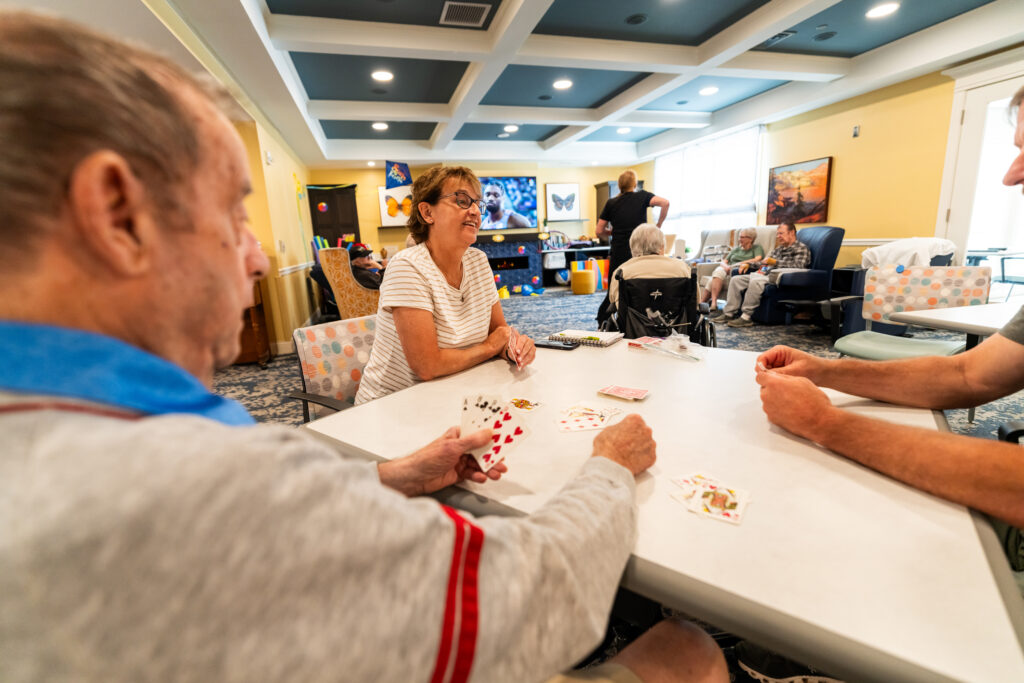
Memory care is a specialized type of residential care designed specifically for people living with Alzheimer’s and other forms of dementia. Unlike general home care, it combines a secure, dementia-friendly environment with a team trained in cognitive care, available 24 hours a day.
Memory care is typically the better fit when:
- Safety has become a daily concern (wandering, falls, kitchen hazards)
- Your loved one needs supervision or help around the clock, including overnight
- Behaviors like agitation or sundowning are hard to manage at home
- A family caregiver is burning out
- Isolation and lack of routine are accelerating decline
“Sometimes when a family is weighing memory care, we sense guilt or shame,” Galvan says. “Loved ones can be hard on themselves. But how is it fair to expect one untrained relative or spouse to provide round-the-clock supervision, manage difficult behaviors, and keep someone safe? These are all things a trained team does in shifts.
“And yet with dementia, families sometimes think they must do it alone or with minimal help. That belief serves nobody: not the family and not the person living with dementia.”
Memory Care Vs. Home Care: Key Differences
| Factor | Home Care | Memory Care |
|---|---|---|
| Safety and environment | Home can be made safer but not fully safe for advanced dementia | Purpose-built: secured exits, fall-aware layout, overnight staff |
| Hours of coverage | Limited by hours hired and budget | 24 hours a day, 7 days a week, 365 days a year |
| Staff training | Family members and aides may not be dementia-trained | Team members trained specifically in cognitive care |
| Social connection | Can become isolating | Structured, dementia-friendly daily activities |
| Best stage | Early stage | Moderate to advanced |
| Cost structure | Hourly rates that rise sharply with round-the-clock need | Daily rate includes housing, care, meals, housekeeping, and activities |
| Support for family | Heaviest load often on one or two relatives, increasing risk of burnout | 24/7 responsibility shifts to a trained team |
Safety and Environment
This is the biggest difference. At home you can add grab bars and locks, remove clutter and tripping hazards, and even move rooms around to avoid using the stairs. But it’s far harder to make a home safe once dementia has advanced.
Memory care environments are purpose-built: secured exits to prevent wandering, layouts that reduce confusion and fall risk, and caregivers present overnight.
“Because dementia progresses over time, it’s a question of when, not if, safety is compromised at home,” Galvan explains. “And that’s simply because homes are built for individuals without cognitive, sensory, and memory challenges. No home has a trained caregiver who is alert and able to help all night. No home has a secure outdoor area that lets residents spend time gardening. Or a kitchen area with secured appliances. Or lowered beds and windowsills. Family homes just aren’t designed to be memory care neighborhoods.”
Level and Type of Care
Home aides provide valuable help, but coverage is usually limited by hours and budget, and aides may not be specially trained in dementia care. Memory care provides continuous coverage from staff trained specifically in cognitive decline – the difference between help with tasks and a care model built around the disease.
Social Connection and Routine
People with dementia tend to do better with structure and gentle social engagement. At home, days can become isolating, especially when a caregiver is stretched thin. Memory care builds the day around dementia-friendly activities and consistent routine.
Support for the Family
Home care often places the heaviest load on one family member. Memory care shifts that around-the-clock responsibility to a trained team. This frees family members to go back to being a daughter, a son, or a spouse, rather than a caregiver.
“After a few weeks of visiting their loved one in their new home, we tend to have the same conversation with family members,” Galvan says. “It’s ‘I can’t believe we didn’t do this sooner’ and ‘I get to be a daughter again.’ It’s amazing how residents respond to having their family be family again — and it goes a long way toward reducing family burnout.”
Memory Care Vs. Home Care Cost: What to Expect
Cost is one of the most-searched parts of this decision, so it is worth addressing honestly.
In-home care is more affordable if a family needs just a few hours per day. But the math changes quickly as needs increase. Around-the-clock home care for dementia often costs more than residential memory care because you are paying for one-on-one staffing by the hour.
“The most useful comparison is not the sticker price: it is the cost of the care your loved one actually needs. A few hours of home help and 24/7 supervised memory care are completely different,” notes Karen Walser, Supportive Living sales counselor for Living Branches. “Even though memory care costs more, it is less costly in terms of a family’s physical, mental, emotional, and spiritual health. And it is less costly in terms of a loved one’s safety.”
How To Decide Between Home Care and Memory Care
Ask yourself three honest questions:
- Is my loved one safe with the current level of supervision, including overnight?
- Is the current arrangement sustainable for the family member providing care?
- Is my loved one engaged and stable, or are their behaviors and emotional state changing?
If the answers point toward no, it is likely time to at least explore memory care before a fall, a wandering episode, or caregiver burnout forces a rushed decision.
“We’re committed to helping families choose what makes sense for them — whether that’s Serenata Memory Care or something else,” Walser says. “But so much depends on whether the conversation begins early. When you’re not under the pressure of a hospital discharge, you have much more flexibility and peace in the decision-making process.”
Still weighing your options? Schedule a visit to Serenata Memory Care or talk with our team about where your loved one is today and what the right level of support might look like.

Frequently Asked Questions
In the early stages, home care is often enough, particularly with strong family support and low safety risks. As Alzheimer’s progresses and needs include overnight supervision, wandering prevention, and trained behavioral support, home care frequently is not enough, and memory care becomes the safer option.
It depends on how much care is needed. A few hours of in-home help a day can cost less than memory care, but around-the-clock in-home care usually costs more than residential memory care because it is billed hourly for one-on-one staffing. The fairest comparison is the cost of the level of care the person actually needs.
In-home care brings help to a person in their own home and is typically limited by the hours hired. Memory care is a secure residential community designed for dementia, with team members trained in cognitive care and present 24 hours a day, plus structured activities and a dementia-friendly environment.
Common signals include unsafe wandering, falls, leaving appliances on, difficulty with bathing or eating, agitation or sundowning that is hard to manage, and caregiver burnout. When safety and sustainability are in question, it is usually time to explore memory care.